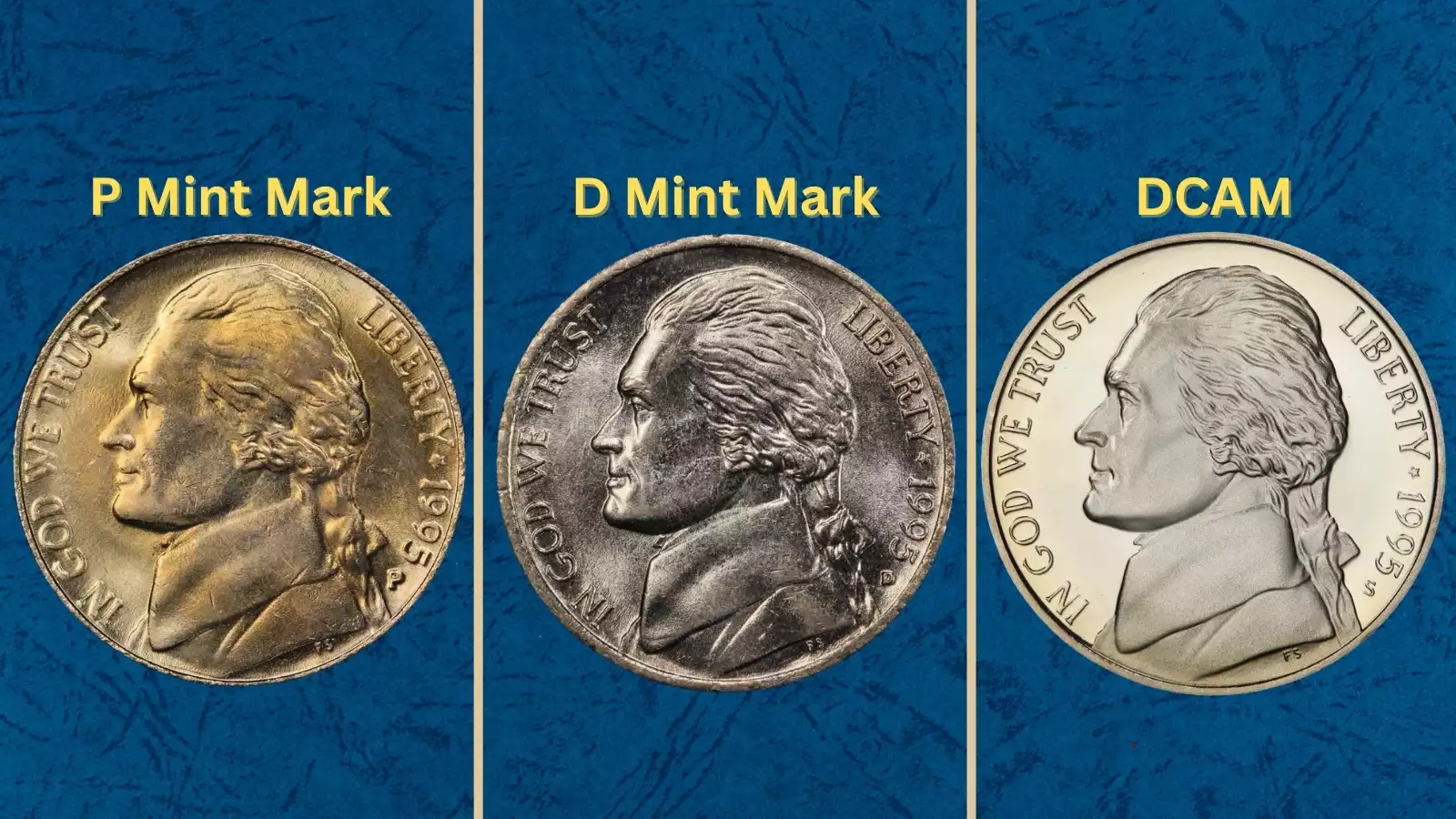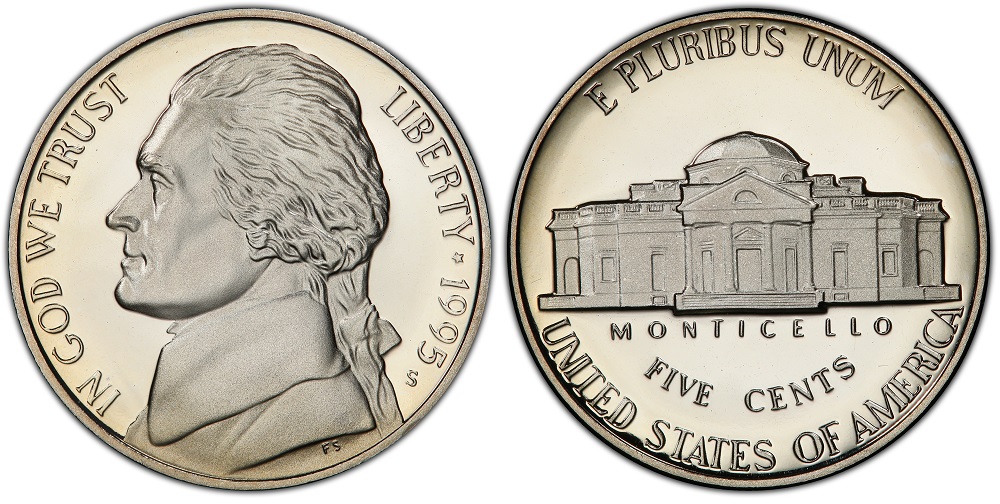
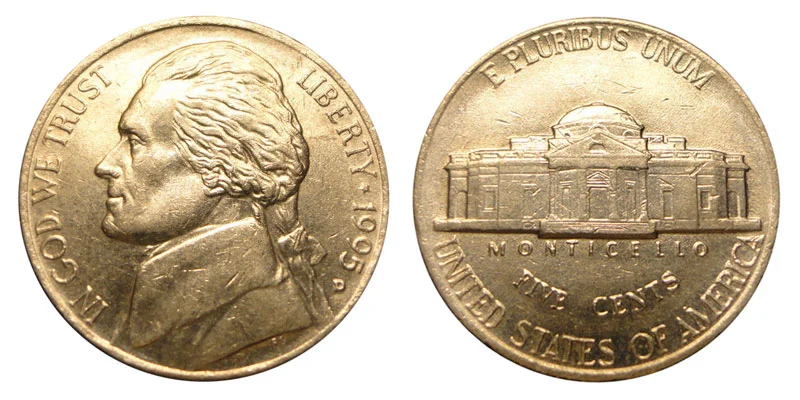
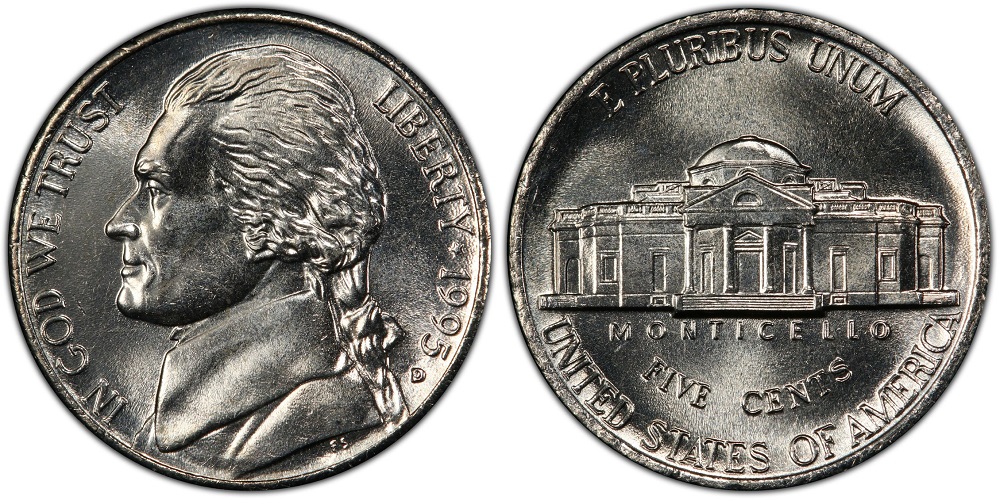
1995 Jefferson nickel obverse and reverse showing Thomas Jefferson portrait and Monticello

The Complete Guide to 1995 Nickel Value

A 1995-D Jefferson nickel graded MS67 Full Steps sold for $1,495 at Heritage Auctions — yet most 1995 nickels circulate at face value. The difference comes down to three things: mint mark, condition, and the coveted Full Steps designation on Monticello's staircase. This guide gives you every tool to find out exactly where your coin lands.

★★★★★ 4.8 / 5 · Rated by 1,342 collectors
Check My 1995 Nickel Value →
$1,495
Top auction — 1995-D MS67 FS (Heritage 2005)
1.66B
Total business-strike coins minted in 1995
3
Known PCGS MS67 Full Steps examples (1995-D)
10–100×
Value multiplier for the Full Steps designation

Full Steps Self-Checker: Do You Have the Key Variety?

The Full Steps (FS) designation is the single most important factor separating a face-value 1995 nickel from one worth hundreds. Use this checker before anything else.

Side-by-side comparison of 1995 nickel reverse: weak steps (common) vs Full Steps (rare and valuable)

❌ No Full Steps — Common

Most 1995 nickels — even uncirculated ones — lack complete step detail. The Monticello staircase shows soft, blended, or interrupted lines because the deepest cavity of the reverse die sits opposite the deepest obverse cavity. Metal flow during striking often fails to fill both completely, leaving weak steps. These coins are worth $0.05–$12 depending on grade.

— vs —

✅ Full Steps — Premium Value

A genuine Full Steps 1995 nickel shows five or six complete, uninterrupted step lines running the full width of Monticello's base — visible under a 10× loupe. These condition rarities command premiums of 10× to 100× over non-FS coins in the same grade. The 1995-D FS is the most prized: only three PCGS MS67 FS examples are known, with the record sale of $1,495.

Run the 4-point Full Steps check on your coin:

Describe Your 1995 Nickel for a Detailed Assessment

Tell us what you see on your coin. Our keyword analyzer will match your description to known 1995 nickel varieties and give you a personalized assessment.

Mention these things if you can

  • Mint mark (P, D, or S)
  • Step lines — full, partial, or flat?
  • Any doubling in date or "IN GOD WE TRUST"
  • Overall luster (bright, frosty, dull)
  • Weight if you have a scale
  • Coin color (normal silver-gray, or copper/bronze?)

Also helpful

  • Rim condition — normal rounded rim or absent?
  • Any off-center appearance?
  • Visible die cracks or blobs of extra metal
  • Any chip, gouge, or missing metal on planchet
  • Coin is smaller or larger than normal?
  • Where you found it (roll, old collection, change)

Want a precise dollar estimate, not just a general assessment?

The calculator below maps your exact mint mark, condition grade, and error type to current market data.

Use the Free Calculator →

Free 1995 Nickel Value Calculator

Answer three quick questions to get an instant market estimate for your coin.

1
2
3

Step 1 — Where was your coin minted?

The mint mark is the small letter (P, D, or S) on the obverse, right of Jefferson's portrait below the date.

Step 2 — What condition is the coin in?

Worn = flat high points; Circulated = slight wear; Uncirculated = original luster but some marks; Gem = nearly flawless.

Step 3 — Does your coin have any of these features?

If you're not sure about mint marks or condition yet, try the 1995 Nickel Coin Value Checker online tool — it's a free third-party resource that accepts uploaded coin photos for an AI-powered identification.

Everything on This Page

Jump to any section:

The Valuable 1995 Jefferson Nickel Errors (Complete Guide)

During the massive 1995 production run of over 1.66 billion nickels, quality-control failures let several significant mint errors reach circulation. These five varieties are the ones serious collectors search for — each raises value well above face value, with the rarest topping four figures.

1995 nickel struck on wrong cent or dime planchet — copper-colored coin smaller than a standard nickel

Wrong Planchet Error

RAREST $300 – $1,380+

A wrong-planchet error occurs when a blank intended for a different denomination is accidentally fed into the nickel press. The 1995 Jefferson nickel design is then struck onto a planchet of the wrong size, weight, and metal composition. Two main subtypes exist for 1995: struck on a Lincoln cent planchet (copper-colored, approximately 2.5 grams, 19 mm) and struck on a Roosevelt dime planchet (silver-colored clad, approximately 2.27 grams, 17.9 mm).

Visual recognition is immediate — the coin's color, weight, and diameter will all be wrong. A nickel struck on a cent planchet looks like a bronze-colored Jefferson nickel and weighs only 2.5 grams rather than the standard 5.0 grams. The design will also be truncated at the edges where the planchet is smaller than the dies. A dime-planchet example measures about 17.9 mm versus the normal 21.2 mm and has a distinct clad edge.

Collectors prize wrong-planchet errors as dramatic, instantly verifiable anomalies that require no specialized knowledge to appreciate. Values depend strongly on planchet type and centering: authenticated cent-planchet errors fetch $690 to $1,380, while dime-planchet errors with strong design centering have sold for $300 to $800. Always obtain PCGS or NGC certification before selling, as counterfeits of this error type exist in the marketplace.
How to spot it
Weigh the coin on a digital scale — a genuine 1995 nickel is 5.0 g; a cent-planchet error is ~2.5 g. Also measure diameter with calipers: normal is 21.2 mm; dime-blank errors measure ~17.9 mm. Color difference is visible to the naked eye.
Mint mark
Both P (Philadelphia) and D (Denver) issues documented; verify die with loupe
Notable
The cent-planchet subtype is considered the most valuable confirmed 1995 error, with authenticated examples reaching $1,380. Always verify with PCGS or NGC — counterfeits of this popular error type are documented in the marketplace.
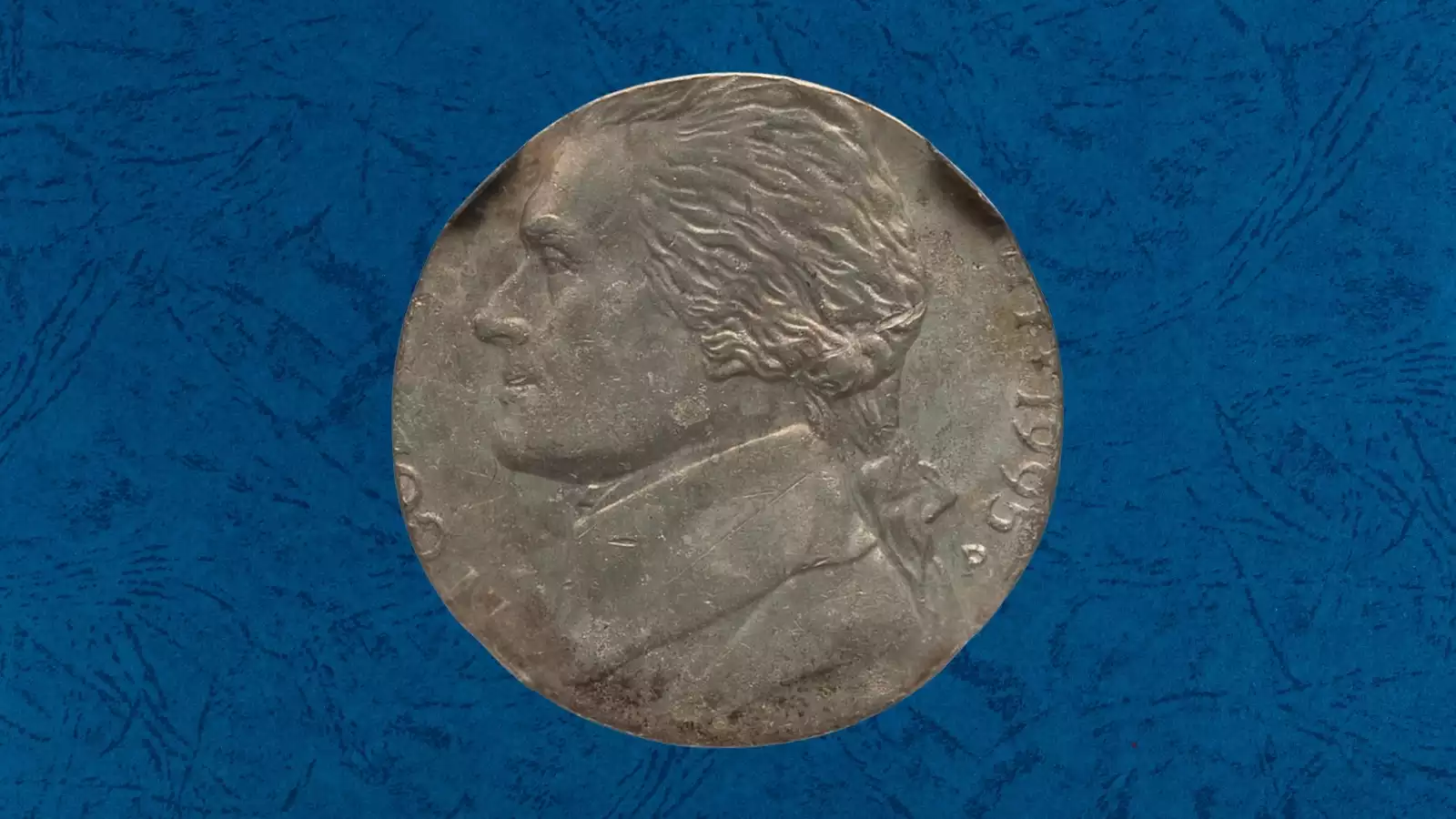
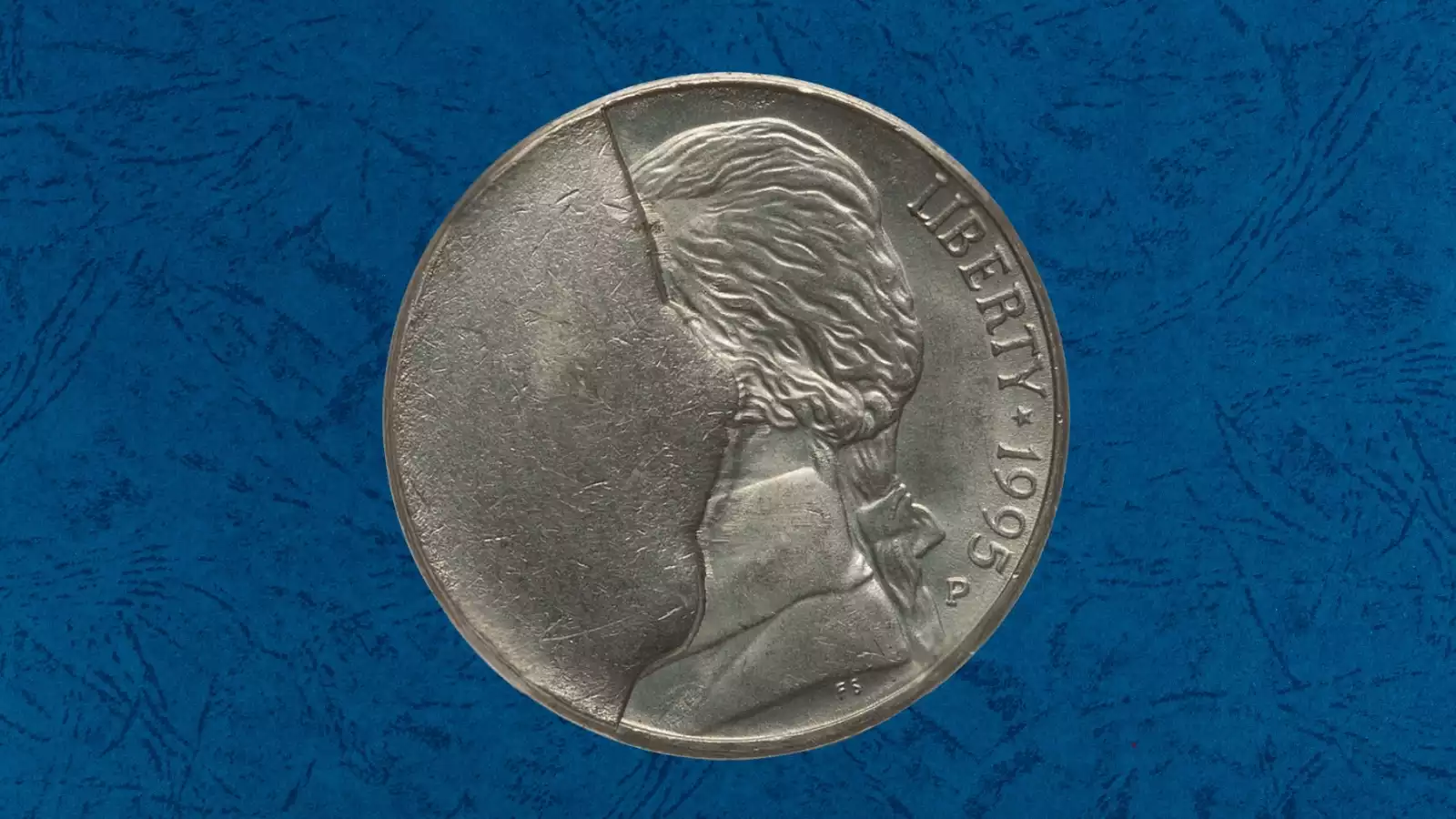
1995 Jefferson nickel broadstrike error showing expanded diameter, flat rim, and spread design

Broadstrike Error

MOST FAMOUS $25 – $200+

A broadstrike error occurs when a planchet is struck outside of the retaining collar — the ring-shaped die component that confines the coin's edge and forms the rim. Without the collar, metal flows freely outward under striking pressure, producing a coin that is visibly wider and flatter than normal, with a missing or greatly reduced rim. The design elements spread toward the edge in a distinctive pattern that makes authentication straightforward.

To identify a broadstrike, examine the rim carefully: it will be flat, missing, or extremely thin on a genuine error. The coin's overall diameter will exceed 21.2 mm — a verifiable measurement with calipers. In some dramatic cases, the coin looks almost wafer-like compared to a normal nickel. A double broadstrike, where the coin is struck twice outside the collar, produces even more dramatic spreading and commands premium prices above the single-strike variant.

Broadstrikes are among the most accessible major errors for beginning collectors because they are easy to identify without specialized equipment. Single broadstrikes on 1995 nickels typically sell for $25 to $100 depending on severity and grade preservation. Combined broadstrike-and-double-strike examples — where both errors occur on the same coin — are significantly rarer and have realized $200 or more at auction. Eye appeal and strike sharpness within the spread design drive value at the upper end of the range.
How to spot it
Check the rim — it will be flat, absent, or greatly reduced. Measure diameter with calipers: a broadstrike is noticeably wider than the normal 21.2 mm. The coin also feels slightly thinner. These differences are visible to the naked eye without magnification.
Mint mark
P (Philadelphia) and D (Denver) circulation-strike issues; most examples documented from Denver due to higher mintage
Notable
Combined broadstrike-and-double-strike errors on 1995 nickels have sold for over $200. Coins-value.com documents broadstrike examples at $1,920+ when combined with a second strike — making the double-broadstrike one of the most dramatic and valuable 1995 error combos known.
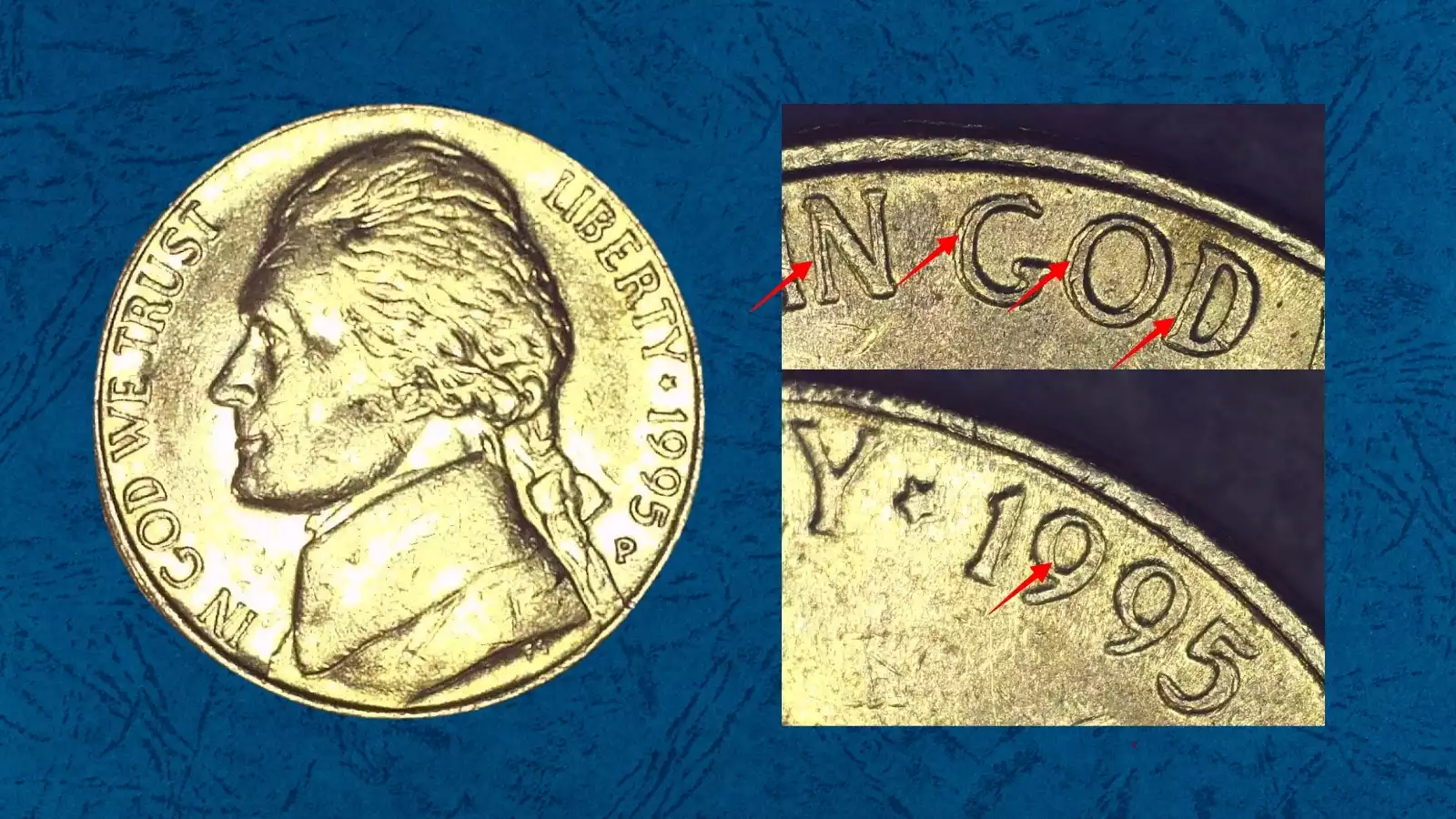
1995 Jefferson nickel doubled die obverse error showing visible doubling in date and lettering under magnification

Doubled Die Obverse (DDO) Error

MOST VALUABLE MS $30 – $200+

A doubled die obverse error results from a misalignment during the die-hubbing process. When the working die is pressed against the master hub multiple times to impart the design, any rotational or linear shift between impressions causes design elements to appear doubled on the finished die — and on every coin struck from it. The 1995 Jefferson nickel DDO shows doubling most prominently in the date digits, Jefferson's portrait details, and the motto "IN GOD WE TRUST."

Under a 10× loupe, a genuine 1995 DDO shows a clear secondary impression of the lettering or date that is offset — not the machine doubling (which appears flat and shelf-like) but a true hub-doubled image with full three-dimensional relief. The doubling on stronger specimens is visible without magnification as a slight blurring or thickening of the date numbers. Subtler DDO varieties require careful loupe examination, particularly in the letters of the motto and Jefferson's cheekbone area.

Strong DDO examples on 1995 nickels are desirable precisely because doubled dies on modern high-mintage coins represent genuine die-preparation errors rather than post-mint damage. Values range from $30 for minor, barely visible doubling to $200 or more for a strong, clearly dramatic doubled die example in uncirculated condition. Eye appeal — how obvious and dramatic the doubling appears — is the primary value driver within this variety, with MS grade being secondary.
How to spot it
Examine the date digits "1995" and the motto "IN GOD WE TRUST" under a 10× loupe. Genuine hub doubling shows a full secondary image with depth; machine doubling appears flat and shelf-like. Check Jefferson's portrait along the cheek and hairline for secondary outlines.
Mint mark
P (Philadelphia) and D (Denver) business-strike issues documented; verify under loupe before claiming attribution
Notable
Both DDO and DDR (Doubled Die Reverse) varieties are listed for 1995 nickels by CoinValueChecker.com and the CONECA error registry. Strong specimens in MS grade with clear eye appeal represent the most desirable examples of this variety type for the year.
1995 Jefferson nickel major die break cud error showing raised lump of metal near coin rim

Major Die Break (Cud) Error

NOTABLE $25 – $100+

A die break — commonly called a "cud" when it involves a large piece — occurs when a section of the working die fractures and breaks away during production. The missing die area creates a void, and on subsequent strikes, the coin's metal flows into that void, forming a raised blob of blank metal on the struck coin. The result is a visible raised lump, typically located on or near the rim, that obliterates the design in that area. Cuds require the die to have failed during active production, meaning multiple coins from the same die pair share the same cud location.

Identification is straightforward: a genuine cud error shows a raised area of featureless, smooth metal where design elements should be. The location is almost always at or touching the rim, because rim stress is where dies most commonly fracture under striking pressure. Minor die cracks — hairline fractures that don't yet cause metal to flow — appear as raised lines across design elements and are more common and less valuable than full cuds.

Value for 1995 nickel cud errors scales directly with the size of the affected area. Minor die cracks add only $1–$5 above face value, as they are relatively common on high-production dies. Medium cuds covering a quarter-inch of rim area command $25–$50. Large cuds consuming multiple design letters or a significant portion of the border can fetch $50–$100 or more depending on the dramatic visual impact and overall coin condition. The obverse die break / cud variety specific to 1995-P is documented by error-coin specialists.
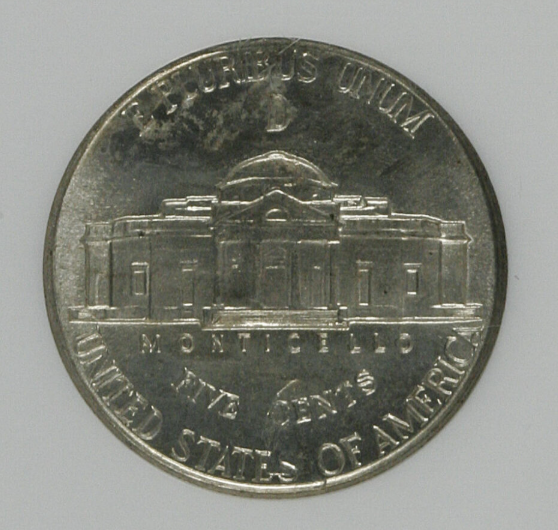
How to spot it
Look for a raised, smooth, featureless blob of metal at or touching the rim on either the obverse or reverse. The cud will be noticeably elevated above the coin's surface — even visible to the naked eye on large examples. A 10× loupe confirms the clean, sharp boundary between normal design and the cud.
Mint mark
1995-P (Philadelphia) obverse die break specifically documented; both P and D issues may show die cracks
Notable
CoinValueApp.com and coins-value.com document major cud errors on 1995 nickels reaching $840 for dramatic large examples. The 1995-P obverse die break is a specifically named variety in error coin references. Die cracks without full cud formation are far more common and add minimal value.
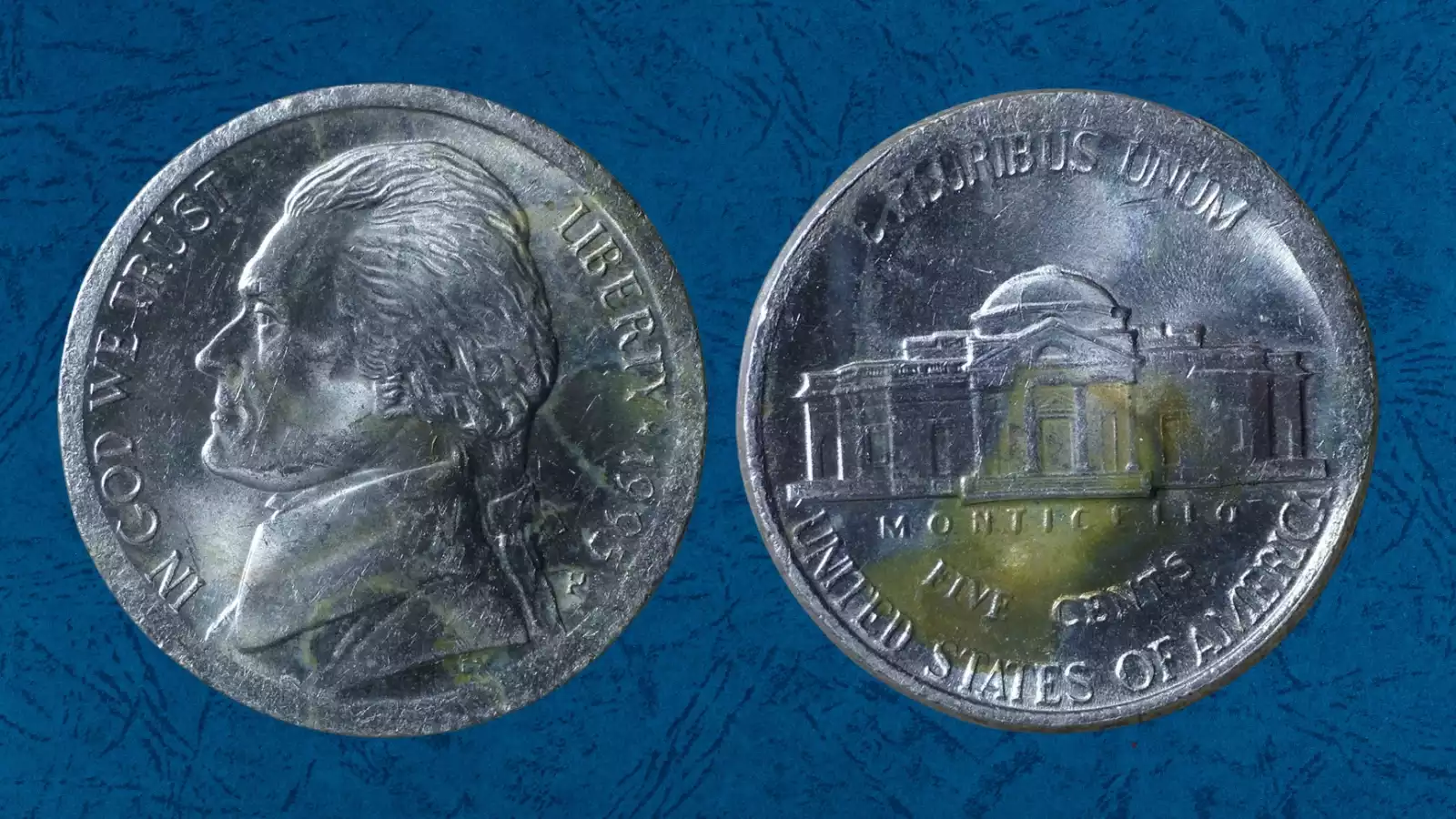
1995 Jefferson nickel lamination error showing peeling metal flap and surface delamination

Lamination Error

BEST KEPT SECRET $5 – $100+

A lamination error occurs when impurities in the metal alloy, inclusions in the planchet, or improper annealing during blank preparation cause the coin's surface to split and peel. On a 1995 Jefferson nickel, this appears as a thin flap of metal lifting away from the coin's face, a missing chip of metal leaving a void, or a visible crack running through the coin's surface. The 1995 nickel's solid 75% copper / 25% nickel alloy composition — unlike modern clad coins — means laminations develop as true splits through a homogeneous alloy rather than delaminations at a clad boundary.

Laminations range from barely visible surface flaking to large, dramatic peel-offs covering much of the coin's face. Under a loupe, a genuine lamination shows layered metal with the flap or void having a different surface texture than the surrounding coin. The boundary between normal metal and the lamination is typically irregular and slightly raised. A "split-before-strike" lamination, where the planchet split before entering the press, shows the split edges on both the obverse and reverse.

Most collectors encounter minor lamination errors — small surface flakes that add only $5 to $10 above face value. Moderate laminations with visible peeling across 20-30% of a face are worth $20–$50. Dramatic specimens with large missing metal areas, or the rare "split-before-strike" subtype showing the split on both sides of the coin in high-grade uncirculated condition, can exceed $100. These make an excellent entry point into 1995 nickel error collecting due to their lower price point and easy authentication.
How to spot it
Look for a flap or void of metal on the coin's surface — the flap will have a layered, irregular edge visible under a 10× loupe. Missing metal areas leave a clearly defined void with different surface texture underneath. Distinguish from post-mint damage (PMD) by checking whether the metal void has a sharp, raised boundary.
Mint mark
Both P (Philadelphia) and D (Denver) business strikes; most examples attributed to high-speed press production where planchet preparation flaws go undetected
Notable
CoinValueChecker.com notes that "split-before-strike" lamination examples — showing the split on both coin faces — are especially prized and can exceed $100 in high-grade uncirculated condition. Minor surface laminations are the most frequently encountered 1995 nickel error type overall, making authentication and grading knowledge essential.

Think you've spotted one of these errors on your coin?

Run it through the calculator with the matching error box checked — you'll get an instant value range based on current market data.

Check Your Error Coin Value →

1995 Nickel Value Chart at a Glance

This table covers all major 1995 varieties across every condition grade. For a complete in-depth illustrated 1995 nickel identification walkthrough and grading reference, see the linked guide. Highlighted rows mark the most collectible varieties.

Variety Worn (G–VG) Circulated (F–AU) Uncirculated (MS60–65) Gem (MS66–67+)
1995-P (Philadelphia) $0.05–$0.15 $0.15–$0.90 $1–$10 $10–$78
1995-P Full Steps ★
Signature variety
$0.15 $0.60–$0.90 $2–$50 $50–$430+
1995-D (Denver) $0.05–$0.15 $0.15–$0.90 $1–$12 $12–$41
1995-D Full Steps 🔥
Top auction record
$0.15 $0.60–$0.90 $2–$60 $60–$1,495+
1995-S Proof DCAM $2–$35 (PR)

★ = Signature variety (gold row) | 🔥 = Top auction record holder (red row) | Values based on PCGS price guide and Heritage Auctions data · 2026 edition

🪙 CoinHix lets you photograph your 1995 nickel and cross-check your condition estimate against thousands of graded examples in seconds — a coin identifier and value app.

1995 Jefferson nickel mintage overview — Denver Mint facility or group of typical 1995 nickel specimens

1995 Jefferson Nickel Mintage & Survival Data

Three U.S. Mint facilities produced 1995 nickels. Philadelphia and Denver struck circulation coins for everyday commerce; San Francisco produced proof-only collector coins. Combined business-strike mintage exceeded 1.66 billion pieces — one of the highest production years in Jefferson nickel history.

Mint Mint Mark Mintage Type Survival (MS65+)
Philadelphia P 774,156,000 Business strike Common; Full Steps scarce
Denver D 888,112,000 Business strike Common; MS67 FS — 3 known (PCGS)
San Francisco S 2,797,481 Proof only (DCAM) ~95% survival; 1,350+ at PR70 DCAM
Total 1995 1,665,065,481 All facilities combined

Composition Specifications

Designer

Felix Schlag

Composition

75% Copper, 25% Nickel

Weight

5.00 grams

Diameter

21.20 mm

Edge

Plain (smooth)

Face Value

$0.05

1995 Jefferson nickel grading strip showing four condition levels: worn, circulated, uncirculated, and gem MS

How to Grade Your 1995 Jefferson Nickel

Grading a Jefferson nickel means evaluating wear on the high points of Jefferson's portrait plus the strike quality and step detail on Monticello's reverse. Here are the four key condition tiers:

G–VG

Worn

Jefferson's portrait is flat and lacks fine hair detail. Monticello is recognizable but has little architectural relief. The steps at the base are completely flat. These coins are worth face value or a small premium. Check weight and color for potential wrong-planchet errors even in worn condition.

F–AU

Circulated

Fine to About Uncirculated examples show varying amounts of wear on Jefferson's cheek, hair strands above the ear, and the columns and steps of Monticello. The higher the grade within this range, the more detail remains. AU-58 coins may have just a trace of wear on the very highest points with nearly full luster.

MS60–65

Uncirculated

No wear from circulation — original luster intact. However, contact marks from coin-on-coin contact in bags significantly reduce grade within this range. Check the obverse fields and Jefferson's cheek for bag marks. Examine the reverse steps closely: even MS64 coins frequently lack Full Steps due to the strike challenge inherent in the design.

MS66–67+

Gem

Nearly flawless surfaces with strong eye appeal. At this level, the Full Steps designation becomes the primary value driver — a gem 1995 nickel without FS is worth $12–$78, while a gem with FS can be worth $400–$1,495+. Inspect the Monticello steps with a 10× loupe for five or six complete, unbroken lines.

Pro Tip — The Full Steps & Strike Quality Test: Jefferson nickels are notorious for weak strikes because the highest-relief area of the obverse (Jefferson's hair above the ear) sits directly opposite the deepest cavity of the reverse (Monticello's steps). Even gems can fail the Full Steps test. When grading, always evaluate the reverse first — if the steps are flat, the coin cannot earn the FS designation regardless of how sharp the obverse looks.

📱 CoinHix lets you photograph your nickel's reverse and compare it against PCGS-certified Full Steps examples to match your coin's condition — a coin identifier and value app.

Where to Sell Your Valuable 1995 Jefferson Nickel

Where you sell matters almost as much as what you have. Here are the four best venues for 1995 nickel sellers in 2026:

🏛️ Heritage Auctions

Heritage is the gold standard for high-grade and error 1995 nickels. The top recorded sale for this date ($1,495 for a 1995-D MS67 FS) was achieved through Heritage. Submit your coin only after PCGS or NGC certification. Heritage charges a seller's commission, but competitive bidding often pushes prices well above estimates for genuine condition rarities like Full Steps examples.

Best for: MS66+ Full Steps coins, dramatic errors, certified examples worth $100+.

🛒 eBay

eBay remains the most liquid market for mid-grade 1995 nickels. Review the recent sold prices for 1995-P Jefferson nickels on completed eBay listings before setting your asking price — active comps prevent overpricing. Certified coins (PCGS or NGC slabs) sell more reliably and at higher prices than raw (ungraded) coins, especially for uncirculated and Full Steps examples where buyers can't personally verify the grade.

Best for: MS60–65 raw coins, mid-range errors, proof sets, bulk lots.

🏪 Local Coin Shop

A local coin dealer offers immediate payment without shipping risk. Expect to receive roughly 50–70% of retail value, as dealers need margin. Local shops work best for circulated coins, minor errors, and situations where you want instant cash rather than waiting on an auction or eBay sale. Call ahead to confirm the dealer buys modern coins — some specialize only in older material.

Best for: Bulk circulated nickels, quicky sales, beginners unfamiliar with online selling.

💬 Reddit r/Coins

The r/coins and r/CRH (Coin Roll Hunting) subreddits have active buying communities and collectors who specialize in Jefferson nickel varieties. You'll often get better than dealer prices for interesting pieces while avoiding auction fees. Post clear, high-resolution photographs of both sides. The community will authenticate and help you price before you commit to a sale.

Best for: Error coins seeking attribution, connecting with specialist buyers, getting free authentication opinions.

💡 Get It Graded First (When It Makes Sense): For any 1995 nickel that appears to be MS66 or higher, potentially has Full Steps, or shows a confirmed minting error, PCGS or NGC certification dramatically increases your selling price and pool of buyers. Grading fees run $20–$40+ per coin. The math works when your expected post-grade value is at least 3× the grading fee — a 1995-D MS67 FS candidate easily clears that bar. For circulated coins worth under $1, skip the fee entirely.

Frequently Asked Questions — 1995 Nickel Value

How much is a 1995 nickel worth?
Most circulated 1995 nickels are worth between $0.05 and $0.67 — barely above face value due to the combined mintage of over 1.6 billion coins. Uncirculated examples in MS60-MS64 typically bring $1 to $8. The real premium comes from high grade (MS66+) or the Full Steps designation. A 1995-D MS67 Full Steps holds the top recorded auction price of $1,495 at Heritage Auctions in January 2005.
What is a 1995-D nickel worth?
The 1995-D nickel had the highest mintage of any 1995 issue at 888,112,000 coins, so circulated examples are worth face value to about $0.67. In uncirculated MS64 condition, expect $1–$17. The coveted Full Steps designation dramatically raises values: a 1995-D MS67 Full Steps achieved $1,495 at Heritage Auctions in 2005, and MS66 Full Steps examples sell for $38–$62 in recent eBay sales.
What is a 1995-P nickel worth?
The 1995-P nickel from Philadelphia had a mintage of 774,156,000. Circulated coins are worth face value to about $0.67. Uncirculated examples fetch $1–$10 depending on grade. The most valuable 1995-P is a Full Steps example: a 1995-P MS67 Full Steps sold for $546 at Heritage Auctions in August 2011. Greysheet lists 1995-P Full Steps pieces ranging from $2 to $285.
What does Full Steps mean on a 1995 nickel?
Full Steps (FS) refers to the architectural steps at the base of Monticello on the reverse of the Jefferson nickel. PCGS requires at least five complete, uninterrupted step lines to award the FS designation. Because the steps are the deepest cavity in the reverse die — directly opposite a deep obverse cavity — many coins lack full detail even when otherwise uncirculated. Full Steps coins command premiums of 10× to 100× over non-FS examples in the same grade.
What is a 1995-S proof nickel worth?
The 1995-S proof nickel was struck at San Francisco with a mintage of 2,797,481 for collector sets. In PR65-PR69 Deep Cameo grades, expect $2–$13. A perfect PR70 DCAM example currently sells for roughly $23–$35, though an early Heritage auction in 2003 set a record of $690 for PR70. That record is now obsolete due to high surviving populations — NGC alone has certified over 1,350 examples at PR70 Ultra Cameo.
What 1995 nickel errors are worth money?
The most valuable 1995 nickel errors include: (1) struck on a wrong planchet — a nickel struck on a cent or dime blank — worth $300–$1,380 depending on type; (2) broadstrike errors where the coin spread beyond its collar, worth $25–$200+; (3) doubled die obverse (DDO) errors showing doubling in the lettering or date, worth $30–$200+; (4) major die break or cud errors, worth $25–$100+; and (5) off-center strikes, worth $15–$100+ depending on severity.
How do I know if my 1995 nickel has Full Steps?
Flip the coin to the reverse and locate the base of Monticello. Using a 10× loupe, count the horizontal step lines at the bottom of the building. You need at least five complete, unbroken lines running the full width of the staircase. Any blending, weakness, or contact marks that interrupt a line disqualify that step. If all five (or six) lines are sharp and continuous from one side to the other, your coin may qualify for the Full Steps designation.
Is a 1995 nickel rare?
No — standard circulated 1995 nickels are extremely common due to a combined business-strike mintage of over 1.66 billion coins from Philadelphia and Denver. However, rarity does exist in two specific contexts: high-grade Mint State coins with the Full Steps designation (only a handful of MS67 FS examples are certified by PCGS) and genuine mint errors such as wrong-planchet strikes. In those scenarios, a common date becomes a condition or error rarity worth significant premiums.
Should I get my 1995 nickel graded by PCGS or NGC?
Professional grading by PCGS or NGC only makes financial sense for 1995 nickels if your coin appears to be MS66 or higher, potentially has the Full Steps designation, or shows a confirmed minting error. Grading fees typically run $20–$40 or more per coin. Since most circulated 1995 nickels are worth $0.05–$0.67, grading is cost-effective only when the expected post-grade value significantly exceeds the submission cost. High-grade FS examples and confirmed errors are the clearest cases for grading.
Where is the mint mark on a 1995 nickel?
The mint mark on a 1995 Jefferson nickel is located on the obverse (heads side), to the right of Jefferson's portrait, just below the last digit of the date 1995. A 'P' indicates Philadelphia, a 'D' indicates Denver, and an 'S' indicates San Francisco (proof only). Philadelphia nickels from this era always carry the 'P' mint mark — the Mint dropped its old habit of omitting the P mark on circulation coins in 1980.

Ready to Find Out What Your 1995 Nickel Is Worth?

Enter your mint mark, condition, and any error features — get an instant value estimate backed by PCGS auction data.

Get My Free Estimate →